


Chamu Leave a Commenton Microsoft Google AI War: How Copilot and Gemini Are Reshaping Search and the Future of the Web June 1, 2026
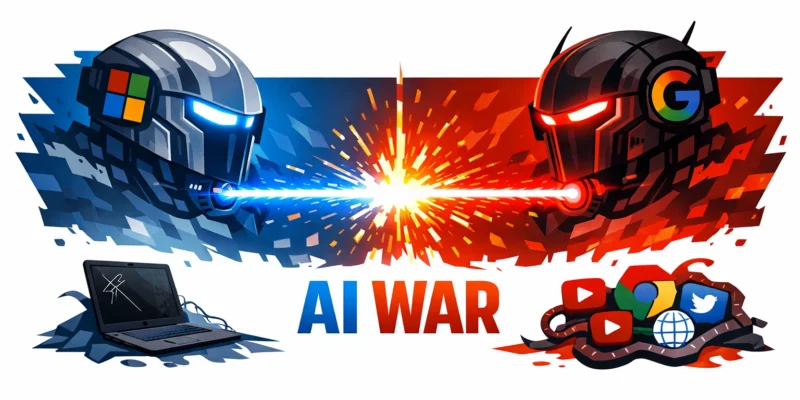
Microsoft Google AI War: How Copilot and Gemini Are Reshaping Search and the Future of the Web
Back in February 2023, the mood inside Microsoft’s Redmond campus was electric. CEO Satya Nadella radiated an unprecedented, almost swaggering confidence, famously declaring to the press that Microsoft had forced the 800-pound search engine gorilla, Google, to “dance.” By executing a masterstroke partnership with OpenAI and integrating cutting-edge ChatGPT technology directly into the Bing search engine, Microsoft scored a massive, early victory. They had cultural momentum, first-mover advantage, and the tech world genuinely believed a complete upheaval of the multi-billion-dollar search market was imminent.
However, fast forward three years to 2026, and the digital landscape looks entirely different. Satya Nadella, along with many tech analysts, vastly underestimated the corporate survival instinct of that 800-pound gorilla. Instead of learning to dance to Microsoft’s tune, Google systematically remodeled the entire ballroom. Using their Gemini AI models, Google has fundamentally altered the structural shape of the internet. Meanwhile, Microsoft has stumbled once again, falling victim not to a lack of technological capability, but to its own deeply ingrained, cyclical corporate weaknesses.
The primary culprit behind Microsoft’s current retreat in the AI search war is a chronic corporate disease: a profound, persistent, and almost institutional negligence of the consumer market.
Microsoft’s History of Abandonment and Consumer Neglect
Throughout Microsoft’s 35-year history of interacting with artificial intelligence and digital assistants, a glaring weakness has emerged: a “shiny object syndrome” where they introduce highly innovative, ahead-of-their-time features to the consumer market, only to unceremoniously abandon them shortly after.
We saw this from the days of ‘Clippy’ in the late nineties, all the way to ‘Cortana,’ which was built to go head-to-head with Apple’s Siri. Cortana was, by many accounts, an excellent digital assistant. Voiced beautifully, possessing great contextual awareness, and deeply integrated into the calendar, it had massive potential. Yet, because Microsoft tragically lost the mobile operating system wars, they completely gave up on Cortana. Without a thriving smartphone ecosystem to live on, they relegated her to a hidden corner of the Windows 10 taskbar before eventually purging her from their software entirely. It has become a depressing, recurring theme: just as everyday consumers begin to embrace a Microsoft innovation, the company gets cold feet and pulls the plug.
This historical blunder has directly and disastrously impacted their latest AI endeavors. Microsoft completely failed to elegantly bring their AI services into the daily lives of everyday people. What started as an exciting, dedicated destination known as “Bing Chat” was awkwardly restructured, rebranded into “Copilot,” and then aggressively forced into every conceivable corner of the Windows 11 operating system.
Instead of building lightweight, native utilities, Microsoft bloated their flagship OS with web-wrapped AI features that choked system resources. The culmination of this tone-deaf approach was the announcement of “Copilot+ PCs” and the deeply invasive ‘Recall’ feature. By attempting to take continuous, unencrypted screenshots of users’ desktops to build an AI memory bank, Microsoft created a privacy nightmare that cybersecurity experts immediately flagged as a massive security risk.
When everyday consumers pushed back against this forced, bloated, and insecure AI experience, Microsoft did what it always does when consumer products fail: it pivoted to the boardroom. They are now aggressively branding Copilot and their AI ecosystem as strictly “Enterprise-focused” tools for productivity. But no matter how much PR spin they apply, the hard truth remains: this sudden shift to the enterprise is merely a cover-up.
Microsoft is retreating to the safety of B2B software subscriptions because they fundamentally failed to win over the hearts, minds, and habits of the global consumer market. If Microsoft’s leadership truly believes that “the consumer market doesn’t matter” as long as they secure lucrative enterprise contracts, they are making a fatal mistake. Winning the consumer mindshare dictates cultural relevance; losing it will eventually darken their future and relegate them to being just another backend IT provider.
Google Search and the Death of the “Natural WWW Experience”
While Microsoft was busy alienating its Windows users and battling PR nightmares over privacy, Google executed a brilliant, ruthless counter-offensive. Capitalizing on its unbreakable, frictionless distribution channels across billions of Chrome browsers and Android devices worldwide, Google delivered the Gemini AI model directly to the masses. They didn’t ask users to download a new app; they injected AI directly into the search bar everyone was already using. However, Google’s undeniable victory in this distribution war is actively paving the way for the destruction of the internet as we know it.
By deeply integrating Gemini directly into the core Google Search engine via “AI Overviews,” the “Natural WWW Experience” we have enjoyed for a quarter of a century is being entirely wiped out. In the past, the internet was a place of serendipitous discovery. When you searched for a topic—whether it was a troubleshooting guide, a travel itinerary, or a recipe—you were rewarded with a journey. You clicked through beautifully crafted blogs, independent investigative journalism, and passionate forums. You engaged with human stories filled with real lived experiences, nuanced emotions, and distinct, quirky voices.
Today, no matter what you search for, the top half of your Google results page is dominated by an emotionless, robotic, AI-generated summary. The internet is rapidly transforming into a homogenized, algorithmic machine that speaks in a single, synthetic, and often hallucination-prone language. Instead of a vibrant library of human thought, the web is becoming a sterile tollbooth where Google acts as the sole gatekeeper. Users are now forced to dig past mountains of synthetic “slop” just to find meaningful, trustworthy articles written by actual human beings.
The Tragedy of Web Publishers and Content Creators
The most devastating and immediate consequence of Google’s AI Overviews falls squarely on the shoulders of web publishers, independent journalists, and content creators—the very people who spent the last two decades painstakingly building the internet’s knowledge base.
A typical website survives on a very delicate economic ecosystem: it relies almost entirely on the advertising revenue and affiliate links generated by user clicks and organic traffic. But Google’s AI is now acting as an apex predator. It actively scrapes the hard work, original research, and proprietary data from these websites to generate its own automated summaries at the top of the search results.
As a result, users get their answers immediately on Google’s homepage and have absolutely zero incentive to click through to the original source. Because of this new “zero-click” environment, website traffic across the globe is plummeting at an alarming rate, and consequently, publishers’ ad revenues are taking a massive, unsustainable hit.
It is a profound economic tragedy and a glaring ethical issue: Google is essentially ingesting content created by hardworking humans for free, repackaging it, and starving the original creators of the income they rightfully deserve. This creates a dangerous “ouroboros” effect—a snake eating its own tail. If this trend continues and independent bloggers, creators, and media outlets are driven into bankruptcy, who will write the high-quality information of tomorrow? Without a thriving human web, Google’s AI will eventually run out of fresh, accurate data to train on, leaving behind nothing but a wasteland of recycled AI hallucinations.
Microsoft’s True Window of Opportunity
Google’s monopolistic, heavy-handed, and web-destroying approach to AI search has ironically handed Microsoft the perfect, perhaps final, opportunity for platform redemption. To win, Microsoft must not try to out-Google Google by forcing more synthetic AI summaries down their users’ throats. They must recognize that consumers are growing fatigued by AI slop.
Instead, Microsoft needs to completely pivot Bing’s identity, positioning it as the ultimate sanctuary for human intelligence and the natural web. If they can offer a search engine that champions deep privacy and provides clean, lightning-fast “Blue Links” that direct users straight to authoritative, human-written articles, they will immediately stand out.
Furthermore, Microsoft has the capital to force Google’s hand financially. If Microsoft overhauls Bing’s monetization structure to offer drastically higher ad-revenue splits and fair referral metrics that actually save web publishers from bankruptcy, they could turn the tide overnight. If the world’s creators and journalists realize they can financially survive—and thrive—with Bing while Google actively starves them, the entire media ecosystem will shift its loyalty to Microsoft, bringing their massive audiences with them.
But to achieve this vision and save the internet, Microsoft must first look inward and cure its oldest disease. They must stop chasing enterprise trends at the expense of user experience, and finally start caring deeply about the everyday consumer.
Stay Ahead of the AI Search Revolution
The competition between Microsoft and Google is reshaping how we search, discover, and interact with information online. As AI tools like Copilot and Gemini continue to evolve, the entire web experience is changing faster than ever before. Don’t just watch this transformation—stay informed, stay ahead, and understand what it means for the future of content, businesses, and everyday users.
Discover more insights on AI, SEO, and digital transformation: