


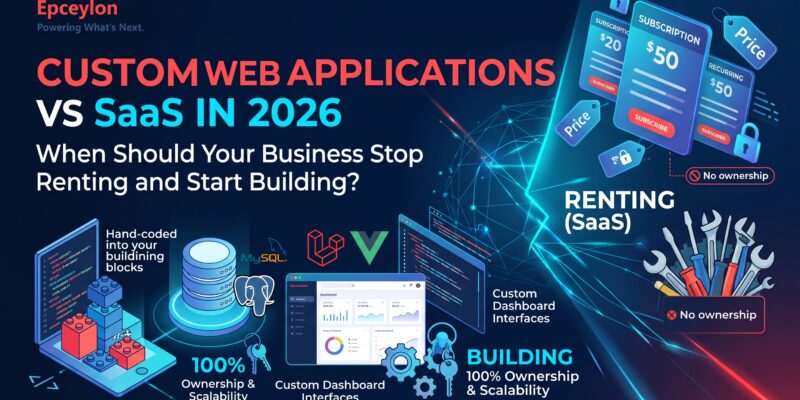
Custom Web Applications vs. SaaS in 2026: When Should Your Business Stop Renting and Start Building?
Every successful company begins with humble digital beginnings.
In the early stages of a business, off-the-shelf software is a lifesaver. You subscribe to a generic CRM for $30/month, manage your inventory on a shared Google Sheet, handle invoicing through basic accounting software, and coordinate client updates over WhatsApp.
It is cheap, fast to set up, and functional enough to get off the ground.
Then your business begins to scale.
Suddenly, you have 15, 30, or 50 team members. What used to be a small $30 software expense has ballooned into SaaS Subscription Fatigue—costing thousands of dollars every month in foreign currency due to punitive “per-user, per-month” licensing fees.
Even worse, your departments are operating in isolated data silos. Your sales team’s CRM doesn’t talk to your warehouse spreadsheet, your billing software requires manual double-entry, and staff members spend hours each day copying and pasting data between five different browser tabs.
In 2026, growing businesses face a critical strategic crossroads: Do you continue renting rigid, one-size-fits-all SaaS tools, or is it time to build a custom web application tailored to your exact operational workflows?
In this comprehensive guide, our engineering team at Epceylon Solutions breaks down the hidden costs of generic SaaS, the strategic benefits of custom web applications, and the exact decision framework to determine when building custom software delivers the highest return on investment.
The 4 Hidden Traps of Generic Off-the-Shelf SaaS
Pre-built SaaS platforms promise convenience, but as companies expand, generic tools inevitably create operational friction.
The “Per-Seat” Cost Tax
Almost all commercial SaaS tools monetize by charging per user.
A tool costing $40 per user/month might seem affordable for 3 founders ($120/month).
But as your operational staff grows to 35 team members, that single tool costs $1,400 every single month ($16,800 / year)—perpetually.
Multiply that across 4 or 5 different SaaS subscriptions, and businesses find themselves spending millions of rupees annually in recurring subscription rents without ever owning a single line of digital IP.
The “Frankenstein Stack” & The Spreadsheet Band-Aid
When off-the-shelf software cannot accommodate your unique business rules (such as local courier tracking, specific commission structures, or custom billing approvals), teams resort to workarounds. They create complex, fragile Google Sheets to bridge the gaps. One accidental cell deletion or broken formula throws off inventory counts, leading to delayed orders and frustrated clients.
Severe Feature Bloat & Poor Usability
Enterprise SaaS tools are built to cater to thousands of different companies across dozens of industries. As a result, 80% of their feature sets are irrelevant to your daily operations. Your team is forced to navigate clunky, cluttered dashboards, resulting in steep employee onboarding curves and frequent operational errors.
Zero Data Sovereignty & Vendor Lock-In
When you rely entirely on third-party SaaS platforms, your proprietary customer lists, pricing histories, and transaction data reside on another company’s server. If that provider doubles their subscription prices, alters their API terms, or faces regional downtime, your entire business operations are held hostage.
What Is a Custom Web Application? (And How It Differs from a Website)
It is essential to clarify the distinction between a traditional website and a web application:
A Website (e.g., WordPress brochure site): Primarily informational. It delivers content, blogs, case studies, and brand credibility to external visitors.
A Custom Web Application (e.g., built on Laravel & Vue.js): An interactive, data-driven software engine that executes complex business logic, manages relational databases, automates internal processes, and solves specific operational problems.
Examples of Custom Web Applications We Build:
Custom Internal ERPs & Operations Dashboards: Unifying inventory, multi-branch stock transfers, automated billing, and employee task delegations under one clean interface.
Dedicated Client / Vendor Portals: Secure self-service web apps where clients can track project milestones, approve quotes, download invoices, and submit support tickets 24/7.
Automated Quoting & Booking Engines: Dynamic web tools that calculate real-time pricing based on custom dimensions, materials, or locations, allowing customers to pay instantly.
Logistics & Dispatch Platforms: Real-time routing engines integrated with local courier APIs, automated SMS/WhatsApp dispatch alerts, and digital proof-of-delivery tracking.
The Technical Advantage: Why Laravel & Vue.js Lead the Enterprise Web
When building custom business applications in 2026, framework selection determines whether your software will scale seamlessly or become a maintenance nightmare.
At Epceylon Solutions, our preferred modern architectural stack centers on Laravel (PHP) + Vue.js (or Inertia.js) + Tailwind CSS:
┌─────────────────────────────────────────────────────────────┐
│ FRONTEND: Vue.js / Tailwind CSS                             │
│ Lightning-fast reactive UI | App-like single-page feel      │
│ Optimized for mobile tablets & desktop workstations         │
└──────────────────────────────┬──────────────────────────────┘
                               │ (API / Inertia Handshake)
┌──────────────────────────────▼──────────────────────────────┐
│ BACKEND: Laravel Core                                       │
│ Battle-tested security (CSRF, SQLi protection, RBAC)        │
│ Robust queue workers, scheduled cron jobs, RESTful APIs     │
└──────────────────────────────┬──────────────────────────────┘
                               │
┌──────────────────────────────▼──────────────────────────────┐
│ DATABASE & INTEGRATION LAYER                                │
│ PostgreSQL / MySQL | Redis in-memory caching                │
│ Two-way webhooks with Payment Gateways, WhatsApp & Couriers │
└─────────────────────────────────────────────────────────────┘
Why This Stack Wins for Business Software:
Rock-Solid Security Out of the Box: Laravel includes enterprise-grade protection against Cross-Site Scripting (XSS), SQL Injection, and CSRF attacks by default, ensuring your company’s sensitive financial data remains uncompromised.
Blazing-Fast Reactive User Experiences: Combining Laravel with Vue.js gives internal teams a desktop-quality, snappy user interface without slow page reloads.
Limitless Integration Freedom: Seamlessly connect directly with local payment gateways (PayHere, OnePAY), WhatsApp Business Cloud API, biometric attendance machines, and local courier APIs.
100% Asset Ownership: You own the source code, the database architecture, and the digital property. No monthly per-seat license fees—ever.
The Decision Framework: Build vs. Buy Matrix
| Evaluation Factor | When to BUY (SaaS) | When to BUILD (Custom Web App) |
|---|---|---|
| Business Uniqueness | The process is generic (e.g., standard email marketing or basic accounting). | The process represents your core competitive advantage or proprietary workflow. |
| Team Size & Scaling | Small team (< 5 users) where per-seat fees remain negligible. | Growing team (15+ users) where per-user licensing costs create ongoing financial drain. |
| Data Sensitivity | Low-risk, non-confidential operational information. | Highly confidential customer records, proprietary formulas, or strict compliance mandates. |
| System Integrations | The tool only needs to perform standalone tasks. | You need deep two-way synchronization between inventory, payments, couriers, and CRM. |
Return on Investment (ROI): The Real Math of Custom Development
Consider a mid-sized logistics or distribution business with 25 employees:
The SaaS Route:
Off-the-shelf software suite: $50/user/month = $1,250/month ($15,000 / Rs. 4.5M+ annually).
After 3 years: $45,000 (Over Rs. 13.5 Million) spent, with zero equity gained, ongoing manual errors, and subscription costs that continue indefinitely.
The Custom Web App Route:
One-time custom development investment with an agency partner to build a bespoke application tailored to their exact workflow.
Low hosting infrastructure costs ($40 – $100/month).
Payoff: The software pays for itself within 12 to 18 months, eliminates redundant data entry, saves hundreds of administrative hours, and creates a permanent, proprietary digital asset that increases the enterprise valuation of the business.
Ready to Build Software That Gives Your Business an Unfair Advantage?
In 2026, the most resilient, high-growth companies are not those that force their operations into someone else’s generic template—they are the businesses that automate their unique competitive advantages with tailored digital infrastructure.
At Epceylon Solutions, our engineering specialists design, architect, and build high-performance custom web applications, enterprise client portals, and bespoke management systems powered by Laravel, Vue.js, and modern cloud technologies.