


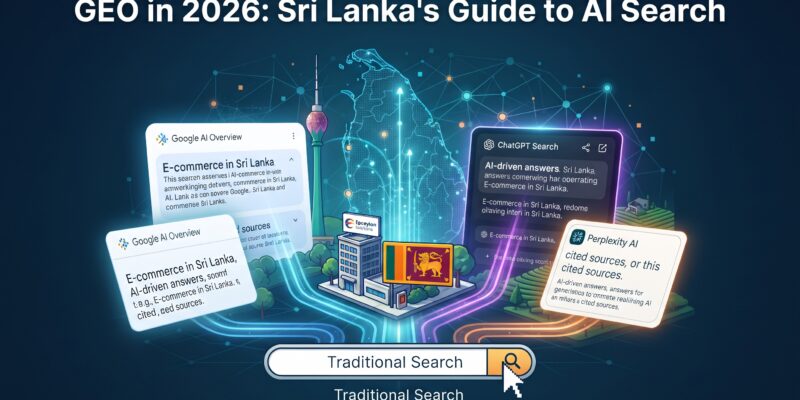
Generative Engine Optimization (GEO) in 2026: How Sri Lankan Businesses Can Rank in Google AI Overviews and ChatGPT
For more than two decades, the formula for achieving organic online visibility was relatively predictable:
Identify high-volume keywords.
Publish keyword-optimized blog articles.
Build quality backlinks.
Compete for one of Google’s coveted first-page search positions.
However, in 2026, traditional SEO strategies alone are no longer enough to maintain a competitive online presence.
The way people discover information, compare businesses, and make purchasing decisions is changing rapidly.
Today, when potential customers in Colombo, Kandy, or anywhere around the world search for services such as “best e-commerce development agency in Sri Lanka”, “how to choose an industrial solar installation company”, or “cost of custom ERP software”, they increasingly encounter AI-generated answers before traditional search results.
Instead of browsing multiple websites, users can now find summarized answers through:
Google AI Overviews – AI-generated summaries displayed within Google Search.
ChatGPT Search – Conversational search experiences supported by web information.
Perplexity AI – An AI-powered answer engine that provides cited sources.
Claude – An AI assistant with web search capabilities.
This shift introduces a new approach to digital visibility: Generative Engine Optimization (GEO), closely related to Answer Engine Optimization (AEO).
Does this mean traditional SEO is dead? Absolutely not.
Instead, SEO is evolving. Businesses must now optimize not only to rank in search results but also to become trustworthy sources that AI-powered search experiences can discover, understand, and reference.
In this guide, the technical and SEO engineering team at Epceylon Solutions explores how generative search works, the differences between SEO and GEO, and a practical five-step strategy Sri Lankan businesses can implement to improve their visibility in the AI search era.
GEO vs SEO 2026: Understanding the Evolution of Search
To understand Generative Engine Optimization, it is important to recognize how traditional search engines and AI-powered search experiences differ.
Traditional Search Engine Optimization (SEO)
Traditional SEO focuses on improving a website’s visibility within search engine results pages (SERPs).
Its major components include:
Keyword research and optimization.
High-quality content creation.
Technical website optimization.
Backlink acquisition.
Page experience and website performance.
Search engine indexing and crawling.
The primary objective is to rank relevant web pages and attract organic visitors.
Generative Engine Optimization (GEO)
Generative Engine Optimization focuses on making website content understandable, trustworthy, and useful for AI-powered search and answer engines.
Its key components include:
Semantic content optimization.
Entity recognition and brand authority.
Structured data implementation.
Original research and information gain.
Clear, factual, answer-focused content.
Consistent brand information across the web.
The objective is to increase the likelihood that your website, expertise, and business information will be considered and cited in AI-generated responses.
SEO vs GEO: Key Differences
| Comparison | Traditional SEO | Generative Engine Optimization |
|---|---|---|
| Primary Objective | Rank in search results | Gain visibility in AI-generated answers |
| Content Strategy | Keyword-focused content | Contextual and answer-focused content |
| Optimization | Keywords and backlinks | Entities, semantics and information quality |
| Search Experience | Traditional search results | Conversational AI-generated responses |
| Authority Signals | Backlinks and website reputation | Multiple trust and authority signals |
| Main Goal | Generate organic website traffic | Increase AI visibility and brand recognition |
The important takeaway: SEO and GEO should work together. Strong technical SEO, helpful content, and a trustworthy online presence provide a valuable foundation for improving AI search visibility.
How AI Search Engines Choose Websites to Cite
AI-powered search engines do not simply select websites based on keyword density.
Depending on the platform and query, they may retrieve information from multiple sources, evaluate relevant passages, and generate an answer with supporting references.
Three important areas can help businesses improve their chances of being referenced.
Information Gain: Publish Something Original
The internet already contains millions of articles covering similar topics.
Publishing another generic article that repeats existing information provides little additional value.
AI search systems can benefit from content that offers genuinely useful information, including:
Original industry research.
Real-world case studies.
Proprietary business insights.
Detailed pricing comparisons.
First-hand technical experience.
Original photographs and project documentation.
Practical implementation guides.
Example:
Instead of publishing:
“E-commerce websites are becoming increasingly popular in Sri Lanka.”
Publish a detailed analysis of your own e-commerce projects, including measurable findings, customer challenges, payment gateway comparisons, and implementation experiences.
Original information gives readers a reason to trust and reference your content.
Entity Authority and Brand Recognition
Search engines and AI systems use entities to understand relationships between businesses, people, locations, products, and concepts.
For example, when an AI system encounters Epceylon Solutions, it should be able to understand:
What the company does.
Which services it provides.
Where it operates.
Which technologies it specializes in.
How it is connected to its official website and social profiles.
Businesses can strengthen their digital identity through:
Consistent company information across platforms.
A detailed About Us page.
Organization and LocalBusiness structured data where applicable.
An accurately maintained Google Business Profile.
Official social media profiles.
Genuine client testimonials and case studies.
Relevant third-party business mentions.
The goal is to build a consistent and verifiable digital identity.
Direct Answers and Semantic Content Structure
AI-powered search experiences benefit from content that clearly answers the user’s question.
Consider someone searching:
“How much does a custom WooCommerce website cost in Sri Lanka?”
An article that hides its answer beneath several lengthy introductory paragraphs may be less useful than one that immediately explains the main cost factors.
A better content structure includes:
A direct answer immediately below the relevant heading.
A comparison table where appropriate.
Supporting explanations and examples.
Technical details and practical recommendations.
This approach makes your content easier for both human readers and search systems to understand.
GEO Strategy Sri Lanka: The 5-Step Optimization Framework
Sri Lankan businesses do not need to abandon their existing SEO strategies to adapt to AI search.
Instead, they should strengthen their websites through a combination of technical optimization, authoritative content, structured data, and consistent brand information.
Here are five practical steps.
Step 1: Implement Comprehensive Schema Markup (JSON-LD)
Structured data helps search engines understand the information presented on your website.
JSON-LD is a commonly recommended format for implementing schema markup.
Important schema types include:
Organization Schema
Provides structured information about your business, including:
Official company name.
Website URL.
Logo.
Contact information.
Social media profiles through
sameAs.
LocalBusiness Schema
Useful for businesses with physical locations or local service operations. It can describe relevant business details such as address, telephone number, opening hours, and geographical information.
Article Schema
Helps identify article information, including its headline, author, publication date, and featured image.
Person Schema
Can help establish the identity and professional information of individual authors and experts.
FAQ Content
Frequently asked questions can be included in well-structured HTML with clear questions and answers. However, adding FAQ schema does not guarantee enhanced search results or AI citations.
Remember: Schema markup improves machine readability, but it does not guarantee that an AI platform will select or cite your website.
Step 2: Follow the Inverted Pyramid Content Structure
The inverted pyramid approach places the most important information first.
Instead of making readers search through lengthy introductions, provide the answer immediately.
A recommended structure for every important blog post or service page is:
1. Direct Answer (First 40–60 Words)
Answer the main question immediately after the relevant H2 or H3 heading.
2. Supporting Information
Use relevant statistics, comparison tables, examples, and practical recommendations.
3. Detailed Explanation
Explain technical concepts, implementation methods, limitations, and real-world applications.
4. Frequently Asked Questions
Include additional questions that potential customers are likely to ask.
This structure improves readability and makes important information easier to identify.
Step 3: Publish Original Sri Lankan Industry Research
One of the strongest ways to differentiate your website is by publishing information that cannot easily be found elsewhere.
Generic content is easy to reproduce. Original research provides additional value.
For example, a Sri Lankan web development company could publish research covering:
Average WooCommerce development costs in Sri Lanka.
Popular payment gateway integrations.
E-commerce checkout challenges.
Website performance benchmarks.
WordPress security trends.
Customer experience improvements.
Business automation adoption.
Consider the following example:
“According to an internal audit of 85 Sri Lankan e-commerce stores, integrating Buy Now Pay Later services increased average order values by 35%.”
This type of statement should only be published if the research was genuinely conducted and the methodology and supporting data can be verified.
Our recommendation: Publish real project findings, original case studies, and transparent industry research instead of relying on unsupported statistics.
Step 4: Optimize for Conversational and Long-Tail Search Queries
People increasingly use natural language when interacting with AI search tools.
Instead of searching only for:
“Web development Colombo”
A potential customer might ask:
“Which web development company in Sri Lanka can build a custom Laravel booking portal with local payment gateway integration?”
This type of query contains several requirements.
Your content should address these requirements through relevant service pages, detailed blog articles, and conversational FAQs.
Consider targeting questions such as:
How much does a custom WordPress website cost in Sri Lanka?
Which payment gateway is best for WooCommerce in Sri Lanka?
How can a business automate customer inquiries using AI?
What is the difference between Laravel and WordPress?
How can small businesses improve their visibility in Google AI Overviews?
Create dedicated, helpful content around the questions that genuinely matter to your target audience.
Step 5: Build Brand Authority Through Digital PR
Your website should not be the only place where your business information exists.
A consistent online presence helps customers and search systems discover and verify your brand.
For Sri Lankan businesses, useful opportunities include:
Reputable local business directories.
Relevant industry publications.
Professional business associations.
Genuine client testimonials.
Guest articles and expert contributions.
Industry-specific case studies.
Consistent LinkedIn company information.
Official social media profiles.
For example, a Sri Lankan technology company can strengthen its online presence by publishing technical insights, participating in relevant industry discussions, and showcasing successfully completed client projects.
Focus on earning genuine mentions and building a credible reputation rather than purchasing irrelevant backlinks.
Generative Engine Optimization Checklist for 2026
Use this checklist to evaluate whether your website is prepared for the changing search environment.
| Optimization Area | Recommended Action | Priority |
|---|---|---|
| Direct Answer Content | Provide concise answers below relevant headings | High |
| Structured Data | Implement appropriate JSON-LD schema | High |
| Original Information | Publish unique research and case studies | High |
| Technical SEO | Improve crawling, indexing and website performance | High |
| Brand Authority | Maintain consistent company information across platforms | High |
| Conversational FAQs | Address relevant customer questions | Medium |
| Content Quality | Publish accurate, useful and well-researched content | High |
| Internal Linking | Connect relevant articles and service pages | Medium |
| Author Information | Provide transparent author and reviewer details | Medium |
| Website Security | Maintain HTTPS and appropriate security controls | High |
How Sri Lankan Businesses Can Measure GEO Performance
Implementing GEO strategies is only the beginning. Businesses should also evaluate whether their efforts are improving online visibility.
Unlike traditional SEO, AI search visibility does not have one universal ranking position or measurement system.
However, businesses can monitor several useful indicators.
1. AI Brand Mentions
Check whether AI-powered search experiences mention your business when users ask relevant industry questions.
2. AI Citation Visibility
Monitor whether your website appears among the cited sources in platforms such as Google AI Overviews and Perplexity.
3. Organic Search Performance
Continue monitoring impressions, clicks, keyword positions, and organic traffic through Google Search Console.
4. Referral Traffic
Use website analytics tools to identify visitors arriving from AI-powered search platforms where referral information is available.
5. Conversion Performance
Measure whether visitors arriving through organic and AI-related discovery channels generate inquiries, leads, and sales.
The objective is not simply to appear in AI-generated answers. It is to turn increased visibility into measurable business value.
Is GEO Replacing Traditional SEO?
No. Generative Engine Optimization is not a replacement for traditional SEO.
Both disciplines address different aspects of online discovery and should be implemented together.
A technically strong website with helpful content, clear business information, good performance, and a credible reputation has a stronger foundation for competing in both traditional and AI-powered search environments.
Businesses that focus exclusively on keyword rankings may miss emerging opportunities in conversational search.
Likewise, businesses that focus only on AI visibility while ignoring technical SEO may weaken their overall search performance.
The most effective approach is to build an integrated strategy combining:
Traditional Search Engine Optimization (SEO).
Generative Engine Optimization (GEO).
Answer Engine Optimization (AEO).
Technical SEO.
Content Marketing.
Digital PR and Brand Authority.
Protect and Scale Your Organic Search Visibility in the AI Era
The rise of generative AI is changing how customers discover businesses, evaluate services, and make purchasing decisions.
For Sri Lankan businesses, this creates an opportunity to establish stronger digital authority and reach potential customers through both traditional search engines and AI-powered platforms.
However, achieving long-term visibility requires more than publishing AI-generated articles or adding schema markup.
It requires a technically sound website, valuable original content, accurate business information, and a consistent digital presence.
At Epceylon Solutions, our engineering and digital growth specialists combine modern web development technologies, including Laravel, Vue.js, and WordPress, with technical SEO, structured data implementation, and AI search optimization strategies.
We help businesses strengthen their digital foundations and prepare for the evolving search landscape.
Ready to Improve Your Website's AI Search Visibility?
Is your website ready for Google AI Overviews, ChatGPT Search, and the next generation of AI-powered search experiences?
Let our technical team evaluate your website and identify opportunities to improve its search visibility.
Get in touch with Epceylon Solutions today to schedule your Free AI Search & Technical SEO Audit.